
6x7
Asahi Pentax 6×7 – the original model, launched in 1969 (first generation)
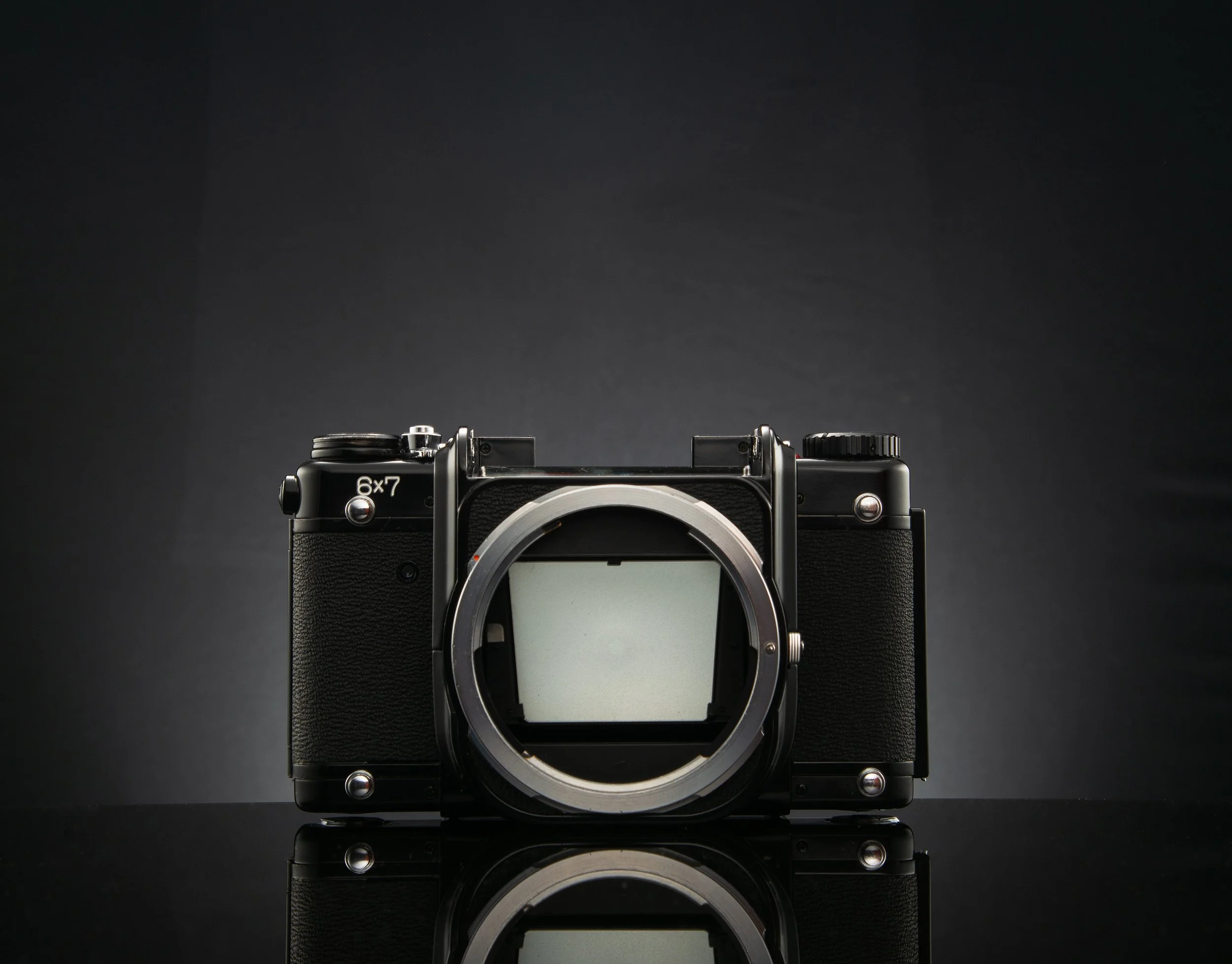
The Pentax 6×7 is a Japanese medium-format SLR roll film camera by Asahi Pentax. Pentax's plans for a 6x7 SLR arose about 1960. However, there were challenges during the camera's development, including changing from a mechanical to an electronic shutter and adjusting the camera for 220 film use, and it took until the 1966 Photokina for the camera to be presented in prototype form as the Pentax 220. The name reflected that it supported 220 film, which had become available in 1965. The prototype had a mixed chrome and black finish. The final version of the Pentax 6x7 launched in 1969 with an all-black finish. It produces 6×7 images on 120 or 220 roll film.
The body is in the style of an oversized 35mm SLR camera; some have referred to it as a "super SLR." The camera has a dual Pentax bayonet lens mount. The inner mount is typically for lenses with a focal length from 35mm to 300mm, while the outer mount is for lengths of 400mm to 1000mm. The shutter is a cloth-based focal plane shutter with speeds of 1 to 1/1000 of a second plus a bulb mode. The camera supports a time (T) mode; to enable this feature the shutter dial has to be set between 1/1000 and X. The shutter release has a locking collar as well as a screw-in cable release connector. For flash synchronization there are two PC sockets on the left-hand side of the mirror housing, one for FP bulb and another for X electronic sync at 1/30 of a second. There is no cold accessory or hot shoe built in. The optional left-hand grip does contain a shoe. The camera is completely battery-dependent, using a 6V PX28/4LR44 battery. The body does not have a built-in exposure meter.
The film transport uses a single-stroke film advance wind lever. The film automatically stops at the correct frame, so no red window is required. The film counter is located on top of the advance lever. Loading film requires opening the film back by pulling the latch on the left side of the back downwards. The left side of the film chamber is for the unexposed film, and the right for the film take-up spool. The base of the camera has film spool knobs that must be pulled out and aligned with the spools. The film backing paper must be aligned with the start indicators in the film chamber, which has two marks--one for 120 and another for 220. Roll film type can be selected by a small knob on the right-hand side of the camera and by sliding the film pressure plate for either 10 or 20 pictures. Sliding the pressure plate also changes the film type reminder window on the back. The camera shutter does not work without film. To test fire, open the camera back and set the film counter dial on a frame number. Close the back while holding the dial. Crank to cock the shutter. The camera locks again when the counter dial has exposed the last frame.